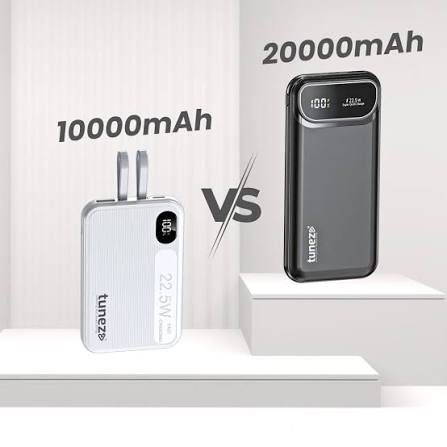
When buying a new power bank, the comparison can seem simple: a 20000mAh model has twice the nominal capacity of a 10000mAh model, so the bigger one must be better.
In real-world use, however, the decision is not that straightforward.
A larger capacity gives you more backup power, but it usually comes with additional size and weight. A 10000mAh power bank is generally easier to carry, but you may need to recharge it more often if you use multiple devices or spend long periods away from a power outlet.
So the real question is not:
Which capacity is bigger?
It is:
How much backup power do you actually need, and how much size and weight are you willing to carry for it?
If you mainly charge one phone during a normal day, 10000mAh may be the more practical choice. If you travel frequently, charge a phone, tablet, and earbuds, or simply need backup power for longer periods, 20000mAh starts to make much more sense.
A useful way to frame the decision is:
Daily Power Needs + Number of Devices + Time Away From an Outlet + Portability + Device Type = 10000mAh or 20000mAh
Quick Answer: 10000mAh or 20000mAh?
If you want the short answer, start with this table:
|
Your Priority |
Better Choice in Most Cases |
|
Everyday use |
10000mAh |
|
Charging one phone |
10000mAh |
|
Lower weight |
10000mAh |
|
Easier portability |
10000mAh |
|
University or daily work |
Usually 10000mAh |
|
Emergency backup |
10000mAh |
|
Very long days away from home |
20000mAh |
|
Longer trips |
20000mAh |
|
Charging multiple devices |
20000mAh |
|
Phone + tablet |
20000mAh |
|
Several days with limited access to power |
20000mAh |
|
Compatible laptop |
20000mAh with suitable output |
In simple terms:
10000mAh → Portability First
20000mAh → Capacity First
Choose 10000mAh if you want a power bank that is easy to carry every day without adding unnecessary weight.
Choose 20000mAh if you need more energy between recharges or want one power bank to support several devices.
What Is the Difference Between a 10000mAh and 20000mAh Power Bank?
The main difference is capacity, but that difference affects much more than how much energy is stored.
|
Factor |
10000mAh |
20000mAh |
|
Nominal capacity |
10000mAh |
20000mAh |
|
Backup energy |
Lower |
Higher |
|
Size |
Usually smaller |
Usually larger |
|
Weight |
Usually lighter |
Usually heavier |
|
Portability |
Excellent |
Less convenient |
|
One phone |
Very suitable |
Sometimes more than needed |
|
Multiple devices |
More limited |
More practical |
|
Tablet |
Useful for top-ups |
More suitable |
|
Laptop |
Depends on output |
More practical with suitable output |
|
Short trips |
Excellent |
Excellent if weight is not an issue |
|
Long trips |
Good |
Usually better |
|
Everyday use |
Excellent |
Depends on size and weight |
|
Heavy use |
More limited |
Better |
There is one important distinction to understand:
Capacity does not determine charging speed.
A 10000mAh power bank with 30W output can charge a compatible device faster than a 20000mAh power bank limited to 20W.
So do not think of 20000mAh as a “faster” version of 10000mAh.
It simply stores more energy.
What Does mAh Mean in a Power Bank?
mAh stands for milliampere-hour, a unit commonly used to describe battery capacity.
In simple terms, it helps indicate how much energy a battery can store relative to another battery. It does not tell you how quickly that energy can be delivered to your phone.
This is why you need to separate two concepts:
10000mAh vs 20000mAh → Capacity
20W vs 30W vs 65W → Power Output
A 20000mAh power bank does not automatically charge a phone faster than a 10000mAh model.
When comparing power banks, you therefore need to consider both capacity and output power, rather than focusing on mAh alone.
Does 20000mAh Mean Twice as Many Charges as 10000mAh?
In terms of nominal capacity, 20000mAh is twice 10000mAh.
However, you should not translate that directly into a guaranteed number of full phone charges.
For example, you cannot simply assume:
10000mAh = 2 Charges
therefore:
20000mAh = 4 Charges
in every situation.
The energy stored inside a power bank does not transfer completely into your phone battery.
It goes through several stages:
Battery Cells → Voltage Conversion → Power Management → Cable → Device
Some energy is naturally lost during conversion and transfer. Efficiency also varies between power banks and can be affected by temperature, the cable, the connected device, and how you use it while charging.
A 20000mAh power bank therefore gives you significantly more usable energy, but the real number of charges should not be calculated by simply dividing its nominal capacity by your phone's battery capacity.
How Many Times Can 10000mAh and 20000mAh Charge a Phone?
The answer depends first on the capacity of your phone's battery and then on power-conversion efficiency and usage conditions.
The following table should be treated as a general guide rather than a guaranteed number:
|
Phone Battery |
10000mAh |
20000mAh |
|
3000mAh |
More than one full charge |
Several charges |
|
4000mAh |
Around 1–2 charges depending on conditions |
Several charges |
|
5000mAh |
Usually one full charge plus additional power |
Several charges, but less than the direct theoretical calculation |
|
6000mAh |
Around one charge or more depending on efficiency |
Clearly more than one full charge |
Actual performance can vary depending on:
-
Power-conversion efficiency
-
Phone battery condition
-
Temperature
-
Using the phone while charging
-
Cable quality and specifications
-
Wired or wireless charging
-
Power bank design
If your main concern is the exact number of phone charges, mAh alone does not tell the full story.
Size and Weight: Will You Actually Notice the Difference?
Usually, yes.
One of the strongest reasons to choose 10000mAh instead of 20000mAh is portability.
A higher-capacity battery requires more stored energy and typically more or larger cells, which is why 20000mAh models tend to be larger and heavier.
However, there is no universal weight for either capacity.
A power bank may include a digital display, built-in cables, extra ports, or other design features that also affect its overall size and weight.
So do not compare only:
10000mAh vs 20000mAh
Also compare:
Capacity + Weight + Dimensions
If you carry your power bank in a pocket or small bag throughout the day, the difference can be significant.
If you already carry a backpack, the additional weight of a 20000mAh model may be a reasonable trade-off for the extra energy.
A useful rule is:
The best capacity is not the one that stores the most energy. It is the one you will actually carry when you need it.
A 20000mAh power bank is not useful if its size makes you leave it at home.
Which Is Better for Everyday Use?
For most light-to-moderate everyday use, 10000mAh is an excellent starting point.
Think about a normal day. You go to work or university, use your phone throughout the day, and perhaps need to recharge your earbuds or give your phone an extra boost before getting home.
In this situation, 10000mAh offers a useful balance between backup energy and portability.
It is particularly practical if you mainly charge:
-
One smartphone
-
Wireless earbuds
-
A smartwatch
-
Devices occasionally while commuting
-
Devices when you still have access to a wall outlet every day
However, if you are a heavy phone user or regularly spend the entire day away from a power source, 20000mAh can still make sense for everyday use.
The decision becomes:
Normal Daily Carry → 10000mAh
Heavy Daily Use → Consider 20000mAh
Which Is Better for Travel: 10000mAh or 20000mAh?
Travel does not automatically mean you need the largest capacity available.
It depends on the length of your trip and how many devices you carry.
Short Trip With One Phone
10000mAh may be more than enough, especially if you can recharge your power bank at your hotel every evening.
Long Travel Day
This is where 20000mAh starts to become more useful, particularly if you rely heavily on your phone for maps, photography, entertainment, communication, and bookings.
Several Days With Limited Access to Power
20000mAh is usually the more practical choice because it provides more backup energy between recharges.
Phone + Tablet + Earbuds
In this situation, 20000mAh is generally more practical than 10000mAh.
A simple decision framework is:
Short Trip + One Phone → 10000mAh May Be Enough
Long Travel Day + Multiple Devices → 20000mAh
Several Days + Limited Outlets → 20000mAh
10000mAh vs 20000mAh for Air Travel
When traveling by plane, mAh is not the only number that matters. You should also pay attention to watt-hours (Wh).
Using an approximate nominal cell voltage of 3.7V:
10000mAh ≈ 37Wh
20000mAh ≈ 74Wh
Both are generally below the commonly used 100Wh threshold for spare lithium batteries.
However, this does not mean every airline applies exactly the same rules.
Policies covering where a power bank must be stored, whether it can be used during the flight, and how many batteries you can carry may vary and can change.
Before flying:
Check the official Wh rating printed on your power bank and review your airline's current battery policy.
Do not rely on mAh alone when determining whether a power bank is suitable for air travel.
Which Capacity Is Better for iPhone?
If you use one iPhone and need a power bank for everyday use, 10000mAh will often provide a better balance between capacity and portability.
The situation changes if you travel or carry several devices.
iPhone Only + Everyday Use
10000mAh is usually enough.
iPhone + AirPods + Apple Watch
10000mAh may still work well for a normal day, while 20000mAh provides more flexibility for extended use.
iPhone + Long Travel
20000mAh becomes more convenient.
But remember:
20000mAh does not mean faster iPhone charging.
Charging speed depends on output power, charging protocol, cable compatibility, and your specific iPhone model.
Which Capacity Is Better for Samsung Galaxy Phones?
The same principle applies to Galaxy devices.
If you use one phone during a normal day, 10000mAh can be a very practical choice.
If your setup includes:
Galaxy + Galaxy Buds + Watch
or:
Galaxy + Tablet
then 20000mAh becomes more useful because of its larger energy reserve.
However, if your priority is Samsung Super Fast Charging, do not choose based on capacity alone.
Think in this order:
Galaxy Model → Supported Wattage → PD/PPS → Power Bank → Cable
Capacity determines how much backup energy is available.
Output power and charging protocols determine whether you can access the fast-charging performance supported by your device.
Which Is Better for a Tablet?
This is where the comparison starts to favor 20000mAh more clearly.
That does not mean a 10000mAh power bank cannot charge a tablet. It simply means that tablets usually have larger batteries, so they consume a greater proportion of the energy stored in the power bank.
A 10000mAh model can be excellent if you only need an additional top-up.
But if you want to rely on the power bank for longer periods, or charge both a phone and tablet from the same battery pack, 20000mAh becomes more practical.
In simple terms:
Phone Only → 10000mAh Can Be Enough
Phone + Tablet → 20000mAh Becomes More Useful
You should also make sure the output power matches your tablet's charging requirements because capacity alone does not determine charging speed.
Which Is Better for Charging a Laptop?
This is one situation where choosing based on capacity alone can easily lead to the wrong product.
It would be incorrect to say:
10000mAh cannot charge laptops
while:
20000mAh can charge laptops.
Output power and charging protocols are critical to compatibility.
A better formula is:
Capacity + USB-C PD + Required Wattage + Compatible Cable = Laptop Charging Setup
You can find 20000mAh power banks that do not provide enough output for a particular laptop, while other models are designed to provide 65W or 100W over USB-C.
From an energy-capacity perspective, however, 20000mAh usually makes more sense for laptop use because laptops consume significantly more energy than smartphones.
If laptop charging is important to you, look for:
20000mAh + USB-C PD + Suitable Wattage + Compatible Cable
rather than choosing a power bank simply because it says 20000mAh.
Does a 20000mAh Power Bank Charge Faster Than a 10000mAh Power Bank?
No.
This is one of the most important points in the entire comparison.
Capacity does not determine charging speed.
Imagine you have:
Power Bank A → 10000mAh / 30W
and:
Power Bank B → 20000mAh / 20W
If your phone can use 30W and the charging protocol is compatible, Power Bank A may charge it faster even though its total capacity is smaller.
The distinction is:
Capacity = How Much Energy You Carry
while:
Wattage + Charging Protocol = How Fast That Energy Can Be Delivered
That is why capacity and output power should always be compared separately.
Is Wattage Related to Power Bank Capacity?
Not necessarily.
You can find many different combinations, including:
-
10000mAh / 20W
-
10000mAh / 30W
-
20000mAh / 20W
-
20000mAh / 30W
-
20000mAh / 65W
-
20000mAh / 100W
So do not use this assumption:
20000mAh = Faster Charging
Instead:
Higher Capacity = More Stored Energy
That capacity can be paired with either low or high output depending on the specific product.
If charging speed matters, compare wattage and technologies such as USB PD, PPS, and Quick Charge alongside capacity.
Which Capacity Takes Longer to Recharge?
Because a 20000mAh power bank stores more energy, it naturally requires more energy to refill.
But that does not mean every 20000mAh model takes twice as long to recharge as every 10000mAh model.
Recharge speed also depends on input power.
Think of it as:
Capacity + Input Wattage + Charger + Charging Protocol = Recharge Time
A 20000mAh power bank may support high-speed USB-C input, while a particular 10000mAh model may have much lower input capability.
You therefore cannot determine recharge time from capacity alone.
If you use your power bank heavily, check input power alongside output power.
Output → Charges Your Devices
Input → Recharges the Power Bank
Is 20000mAh Better for Charging Multiple Devices?
From an energy-capacity perspective, usually yes.
If you only charge a phone and earbuds, 10000mAh may be enough.
But if you regularly charge:
-
Two phones
-
A phone and tablet
-
A phone, watch, and earbuds
-
A laptop and phone
then the additional capacity of 20000mAh becomes much more useful.
However, do not confuse capacity with the number of ports.
Capacity ≠ Number of Ports
And:
Number of Ports ≠ Maximum Speed From Every Port
When several devices are connected, a power bank may distribute its available output between them. If multi-device charging matters to you, check the product's power distribution specifications.
Smaller Power Bank You Recharge More Often vs Larger Power Bank You Recharge Less
This is a practical trade-off that specifications do not always make obvious.
With 10000mAh, you generally get a smaller and easier-to-carry device. However, heavy users may need to recharge the power bank itself more frequently.
With 20000mAh, you have more energy between recharges, but you carry additional size and weight every day.
So ask yourself:
Would you rather carry less weight or recharge your power bank less often?
If the power bank is part of your everyday pocket or small-bag setup, size can be a deciding factor.
If you mainly use it for travel or long days away from home, additional capacity may be more valuable than saving some weight.
Is a 20000mAh Power Bank Worth the Extra Cost?
Not always.
Price is influenced by much more than capacity. Brand, charging power, supported protocols, number of ports, built-in cables, digital displays, and overall design can all affect the final price.
A premium 10000mAh model can therefore cost more than a basic 20000mAh power bank.
Do not compare products only by:
Price ÷ mAh
A better comparison is:
Price + Capacity + Wattage + Protocols + Ports + Input + Weight + Features
If you will not use the additional capacity, paying more for 20000mAh may provide little practical value.
On the other hand, if you constantly drain a 10000mAh power bank and need to recharge it every day, moving to 20000mAh may be a worthwhile upgrade.
When Should You Choose a 10000mAh Power Bank?
Choose 10000mAh if most of the following describe your needs:
-
You mainly charge one smartphone.
-
You want a power bank for everyday use.
-
You carry it in a pocket or small bag.
-
You have access to a power outlet every day.
-
You mainly need emergency backup power.
-
You take short trips.
-
Weight and size matter a lot to you.
-
You do not regularly depend on it for a tablet or laptop.
The main advantage of 10000mAh is not that it is “less.” It is that it can provide a useful amount of backup power without sacrificing too much portability.
If this sounds like your use case, starting with the 10000mAh category makes more sense than paying for capacity you are unlikely to use.
When Should You Choose a 20000mAh Power Bank?
Choose 20000mAh if you:
-
Travel frequently.
-
Spend long days away from a power outlet.
-
Charge several devices.
-
Use a phone and tablet together.
-
Want a larger energy reserve.
-
Need occasional laptop top-ups with a compatible model.
-
Already carry a backpack or work bag.
-
Prefer to recharge the power bank less often.
-
Value backup energy more than minimum weight.
In these situations, the additional size and weight start delivering a real benefit rather than simply becoming extra bulk.
10000mAh vs 20000mAh by User Type
If you are still unsure, your typical use case can help narrow the decision:
|
User Type |
Better Starting Point |
Why? |
|
University student |
10000mAh |
Easy to carry and suitable for a normal day |
|
Employee / commuter |
10000mAh |
Good balance between energy and size |
|
Heavy phone user |
10000 or 20000mAh |
Depends on how long you are away from power |
|
Traveler |
20000mAh |
More backup energy for longer periods |
|
Mobile content creator |
Usually 20000mAh |
Higher consumption and multiple devices |
|
Mobile gamer |
Usually 20000mAh |
Higher battery consumption |
|
Phone + tablet user |
20000mAh |
More energy for both devices |
|
Laptop user |
High-power 20000mAh |
More capacity with suitable output |
|
Emergency backup |
10000mAh |
Usually enough for occasional use |
|
Minimalist |
10000mAh |
Smaller and lighter |
|
Shared/family charging |
20000mAh |
More energy for multiple devices |
These are not strict rules, but they provide a much better starting point than simply choosing the highest capacity available.
5 Questions That Can Help You Choose Between 10000mAh and 20000mAh
Instead of comparing specifications endlessly, answer five practical questions.
1. How Many Devices Do You Usually Charge?
If the answer is one phone, start by looking at 10000mAh.
If you regularly charge several devices, 20000mAh becomes easier to justify.
2. How Long Are You Usually Away From a Power Outlet?
For a normal day where you can recharge at home every evening, 10000mAh may be enough.
For travel and long days, additional capacity offers more flexibility.
3. Where Will You Carry the Power Bank?
Pocket / Small Bag → 10000mAh
Backpack / Travel Bag → 20000mAh Becomes Easier to Justify
4. Do You Only Charge a Phone?
If yes, you may not need 20000mAh.
If you also carry a tablet, several devices, or a compatible laptop, the additional capacity becomes more useful.
5. Which Matters More: Weight or Backup Energy?
Lower Weight → 10000mAh
More Backup Energy → 20000mAh
If most of your answers favor portability, start with 10000mAh.
If most favor travel, multiple devices, and longer periods away from an outlet, start with 20000mAh.
Common Mistakes When Choosing Between 10000mAh and 20000mAh
One of the most common mistakes is buying 20000mAh simply because the number is bigger. If your usage does not require that much backup energy, you may end up carrying extra weight without gaining a meaningful benefit.
The opposite can also happen. Choosing 10000mAh simply because it is smaller or cheaper can become frustrating if you constantly drain it.
Other common mistakes include:
-
Calculating the number of charges using simple division alone.
-
Confusing mAh with wattage.
-
Assuming 20000mAh charges devices faster.
-
Ignoring weight and dimensions.
-
Ignoring input charging speed.
-
Ignoring power distribution.
-
Assuming every 20000mAh model can charge a laptop.
-
Buying a large capacity for occasional emergency use only.
-
Choosing too little capacity despite charging several devices every day.
-
Ignoring cable specifications and charging protocols when fast charging matters.
The goal is not to buy the largest battery you can find.
The goal is to buy the smallest capacity that comfortably covers your actual needs.
How to Choose the Right Power Bank Capacity
Start with your usage rather than the products on the shelf.
A practical decision process is:
Devices → Daily Battery Consumption → Number of Devices → Time Away From an Outlet → Capacity → Weight → Wattage → Protocol → Ports → Input
First, determine which devices you need to charge and how long you usually spend away from a power outlet.
Then choose the capacity.
After that, compare size and weight.
Once you know whether 10000mAh or 20000mAh better suits your needs, move on to wattage, charging protocols, ports, and input speed.
This prevents you from buying 20000mAh simply because the number looks better—or buying 10000mAh only to discover that it cannot comfortably cover your daily usage.
Where to Buy 10000mAh and 20000mAh Power Banks in Jordan
Before choosing a specific product, decide which category fits your lifestyle:
Daily Carry / One Phone → Start With 10000mAh
Travel / Multiple Devices / Longer Runtime → Start With 20000mAh
Then compare wattage, charging protocols, ports, weight, and input speed rather than relying on capacity alone.
On Cart, you can compare different power bank capacities and charging specifications to find an option that matches your devices and how you actually use them.
FAQs About 10000mAh vs 20000mAh Power Banks
10000mAh vs 20000mAh Power Bank: Which Is Better?
Neither capacity is better for everyone. 10000mAh is usually better for portability and everyday use, while 20000mAh is more suitable for travel, long days, and charging multiple devices.
Is 10000mAh Enough for Everyday Use?
For one smartphone and moderate daily use, it often is. However, the answer depends on your phone's battery capacity and how heavily you use it throughout the day.
Is 20000mAh Better Than 10000mAh?
It stores more energy, but that does not automatically make it better. If you do not need the additional capacity, a 10000mAh power bank may be lighter and more practical.
How Many Times Can a 10000mAh Power Bank Charge a Phone?
It depends on your phone's battery capacity, power-conversion efficiency, and usage conditions. The exact number cannot be determined from the 10000mAh figure alone.
How Many Times Can a 20000mAh Power Bank Charge a Phone?
It generally provides more charges than a comparable 10000mAh model, but the actual number depends on your phone, the efficiency of the power bank, and usage conditions.
Does 20000mAh Provide Twice as Many Charges as 10000mAh?
It has twice the nominal capacity, but you should not expect exactly twice as many real-world charges in every case. Conversion efficiency and usage conditions affect the final result.
Which Is Lighter: 10000mAh or 20000mAh?
10000mAh models are generally smaller and lighter, although actual weight depends on the design and features of each power bank.
Is a 20000mAh Power Bank Too Heavy for Everyday Carry?
That depends on the product and how you carry it. It may be less comfortable in a pocket but perfectly practical in a work or travel bag if you need the additional capacity.
Which Is Better for Travel: 10000mAh or 20000mAh?
10000mAh is excellent for short trips and one phone. 20000mAh is generally more practical for longer trips or when you need to charge several devices.
Is 10000mAh Enough for Travel?
It can be enough for short trips if you have one phone and access to a power outlet every day. Longer trips and multiple devices may make 20000mAh a better choice.
Can You Take 10000mAh and 20000mAh Power Banks on a Plane?
At a nominal 3.7V, the two capacities are approximately 37Wh and 74Wh respectively, both below the commonly used 100Wh threshold. However, always check the official Wh rating and your airline's current policy before traveling.
Which Is Better for iPhone?
For everyday use with one iPhone, 10000mAh is often more practical. For travel or charging multiple Apple devices, 20000mAh may be more convenient.
Which Is Better for Samsung Galaxy Phones?
It depends on the number of devices and how long you need backup power. One Galaxy phone may be well served by 10000mAh, while a Galaxy phone plus a tablet or other devices makes 20000mAh more useful.
Which Is Better for a Tablet?
20000mAh is generally more practical because tablets have larger batteries, especially if you also want to charge your phone from the same power bank.
Which Is Better for a Laptop?
20000mAh generally makes more sense from a capacity perspective, but capacity alone is not enough. The power bank must support the USB-C PD output required by your laptop, and you also need a compatible cable.
Does 20000mAh Charge Faster Than 10000mAh?
No. Charging speed depends on wattage, charging protocols, the connected device, and the cable—not capacity alone.
Does mAh Affect Charging Speed?
mAh does not directly determine charging speed. It describes battery capacity, while wattage and charging protocols determine how much power can be delivered to a compatible device.
Is a 10000mAh 30W Power Bank Better Than a 20000mAh 20W Power Bank?
For charging speed, the 30W model may be faster when used with a compatible device. For total backup energy, the 20000mAh model stores more. The better option depends on which factor matters more to you.
Do I Need 20000mAh If I Only Charge One Phone?
Not necessarily. If you have access to a power outlet every day and want the lowest possible weight, 10000mAh may be enough. 20000mAh becomes more useful for heavy use or long trips.
Is 20000mAh Worth the Extra Weight?
Yes, if you will actually use the additional energy. If you only need occasional backup power for one phone, the extra weight may not be justified.
Which Capacity Takes Longer to Recharge?
A 20000mAh power bank stores more energy, but actual recharge time also depends on input power, the charger, and the charging protocol. Capacity alone does not determine recharge time.
Is 20000mAh Better for Charging Two Devices at Once?
It is generally more practical in terms of available energy. However, charging speed depends on total output and how power is distributed between the active ports.
How Do I Know Which Power Bank Capacity I Need?
Consider how many devices you charge, how much battery you use, how long you spend away from an outlet, and how you plan to carry the power bank. If portability is your priority, start with 10000mAh. If longer runtime and multiple devices matter more, consider 20000mAh.
Conclusion: Should You Choose 10000mAh or 20000mAh?
Choosing between a 10000mAh and 20000mAh power bank should not begin with asking which number is bigger.
Start with how you actually use your devices.
One Phone + Everyday Carry → 10000mAh
Emergency Backup → 10000mAh
Pocket or Small Bag → 10000mAh
Long Travel → 20000mAh
Multiple Devices → 20000mAh
Phone + Tablet → 20000mAh
Laptop → 20000mAh + Suitable Wattage + USB PD
Maximum Portability → 10000mAh
More Backup Energy → 20000mAh
If you will genuinely use the additional energy, a 20000mAh power bank can justify its larger size and weight. If your goal is simply to keep one phone powered through a normal day while carrying the power bank everywhere, 10000mAh will often be the more practical choice.
Ultimately, do not look for the largest capacity you can buy.
Look for the capacity that comfortably covers your needs with the least unnecessary size and weight, then make sure the wattage, charging protocols, ports, and cable compatibility match your devices.